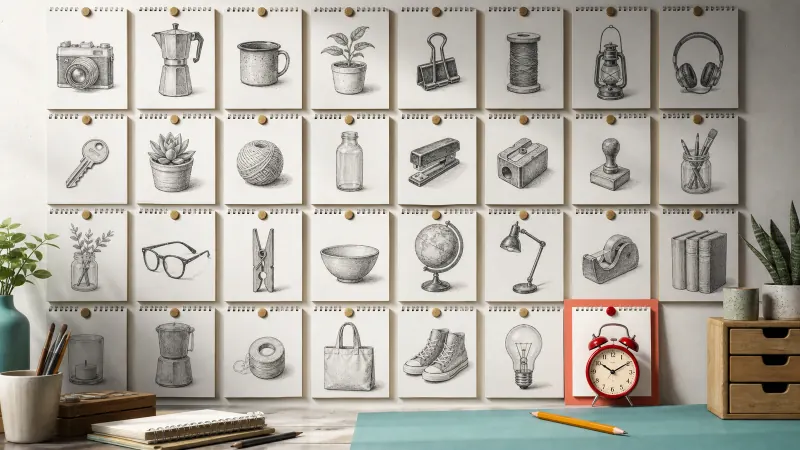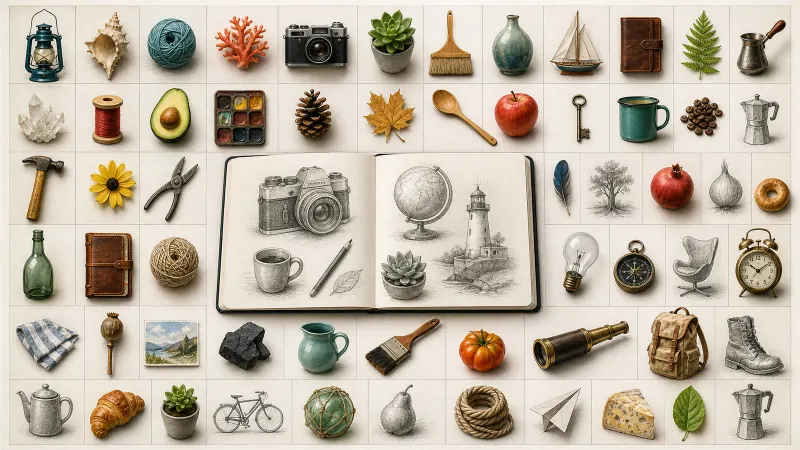
Sometimes you do not want a method or a challenge structure — you just want a list of good things to draw, right now. This is that list: fifty concrete, drawable objects grouped by theme, chosen because each one teaches something specific about form, surface or construction.
Work through them in order, pick at random, or use them as a starting point before switching to an Object Generator for an endless supply. Each group notes what the objects actually train, so you can aim at a weakness rather than drawing whatever is nearest.
Everyday Objects (1–10)
These teach clean proportion and believable ellipses — the foundation everything else sits on.
- Coffee mug
- Table lamp
- Wristwatch
- Pair of scissors
- Umbrella
- Key ring with keys
- Reading glasses
- Alarm clock
- Teapot
- Desk fan
The mug and teapot are deceptively hard. A cylinder seen below eye level has an elliptical rim, and getting that ellipse wrong is the most common beginner error in still life. Draw the full ellipse lightly, then cut away the hidden half.
Nature (11–20)
Organic subjects train irregularity. Nothing here is symmetrical, so you cannot lean on construction shortcuts.
- Pine cone
- Seashell
- Oak leaf
- River stone
- Sunflower
- Feather
- Mushroom
- Tree stump
- Cactus in a pot
- Bird nest
The pine cone and nest are the valuable ones. Both are made of many small repeated parts, and the lesson is to describe the pattern rather than count every scale or twig. Suggesting mass is a more advanced skill than rendering detail.
Food and Kitchen (21–30)
Food covers a wide range of surfaces in a small space: glossy, matte, translucent and porous.
- Half a lemon
- Bunch of grapes
- Slice of watermelon
- Loaf of bread
- Fried egg in a pan
- Wine glass
- Cupcake with icing
- Garlic bulb
- Stack of pancakes
- Whole pineapple
The cut lemon is a small masterclass. It has a matte rind, a translucent interior, a wet highlight and radial structure — four separate surface problems in one subject, at a scale you can finish in twenty minutes.
Choose subjects by the problem they contain, not by how appealing they look. A cut lemon teaches more than a pretty landscape.
Tools and Machines (31–40)
Hard-surface objects train straight lines, accurate angles and mechanical logic.
- Hammer
- Adjustable wrench
- Bicycle
- Sewing machine
- Hand drill
- Camera
- Padlock
- Watering can
- Toolbox
- Typewriter
The bicycle is famously difficult and worth attempting early. Most people cannot draw one from memory even though they have seen thousands, which makes it the clearest possible demonstration that seeing and observing are different skills.
Clothing and Fabric (41–45)
Drapery is where many otherwise capable artists stall, because folds follow rules that are not obvious until you look for them.
- Hanging shirt on a hanger
- Pair of boots
- Wide-brimmed hat
- Folded scarf
- Backpack
Hang the shirt and look for where fabric is supported and where it falls. Folds radiate from support points; once you see that, drapery stops being random and becomes structural.
Transport and Large Forms (46–50)
These push you into perspective, where a small angular error becomes obvious.
- Rowing boat
- Hot air balloon
- Vintage car
- Steam locomotive
- Lighthouse
Start with the balloon and lighthouse — both are simple solids of revolution. Save the car for later; reflective compound curves are one of the hardest surfaces to render convincingly.
How to Choose the Right Subject Today
Fifty options is itself a decision, so use a filter rather than scanning the whole list. Three quick ways to narrow it:
| If you have | Pick from | Why |
|---|---|---|
| Ten minutes | Everyday, Food | Small, single-form subjects that finish cleanly |
| An hour | Nature, Tools | Enough structure to reward sustained observation |
| Low motivation | Everyday | Familiar shapes lower the barrier to starting |
| A plateau | Transport, Clothing | The categories most artists quietly avoid |
| Only a phone | Food, Nature | Most of it is already in your kitchen or garden |
A word of warning about the appealing subjects. The sunflower and the seashell are the ones people gravitate to, and they are pleasant to draw — but the stapler and the folding chair will improve you faster, precisely because you have no stored template for them. Alternate between subjects you want to draw and subjects you should.
How to Get More Out of the List
A single list, however good, eventually runs dry. A few ways to extend it:
- Rotate the angle. Draw the same object from three viewpoints. Fifty objects become one hundred and fifty studies.
- Change the material. Draw the hammer as if it were glass, then as chrome.
- Combine two. Place the lemon beside the wine glass and treat it as a composition.
- Switch to generated prompts. When the list is exhausted, an Object Generator supplies fresh subjects indefinitely, filtered by the same themes used above.
If you want a structure to hang these subjects on, the thirty-day drawing challenge turns a list into a habit, and the practice guide covers timed drills for each one.
Frequently Asked Questions
What order should I work through these in?
Roughly as listed. Everyday objects build the ellipse and proportion skills that Nature and Food then rely on, and Transport assumes the perspective control developed in Tools.
Should I draw from life or from photos?
From life whenever the object is within reach — most of this list is on your kitchen table. Life drawing gives you depth information a photograph has already flattened.
How long should each object take?
Between ten and thirty minutes. Long enough to observe properly, short enough that fifty subjects remain a realistic goal rather than a year-long project.
What if a subject is too hard right now?
Attempt it anyway and keep the result. Difficulty is where learning happens, and a failed bicycle teaches more than a comfortable mug.
Can I use this list for painting rather than drawing?
Yes, and the Food and Nature groups suit paint particularly well because they contain the widest range of surface temperature and value. Allow more time per subject than the drawing estimates above.
Do I have to work through all fifty?
No. The list is a menu, not a curriculum. Ten objects drawn attentively are worth more than fifty rushed to tick them off.
Pick One and Begin
Choose any number on this list and give it fifteen minutes. When you have worked through the fifty, open the Object Generator and let it hand you the next fifty — the list ends, the practice does not have to.