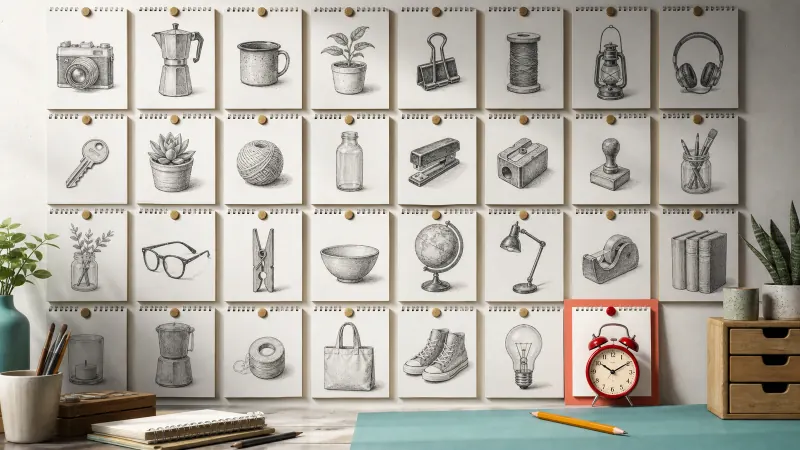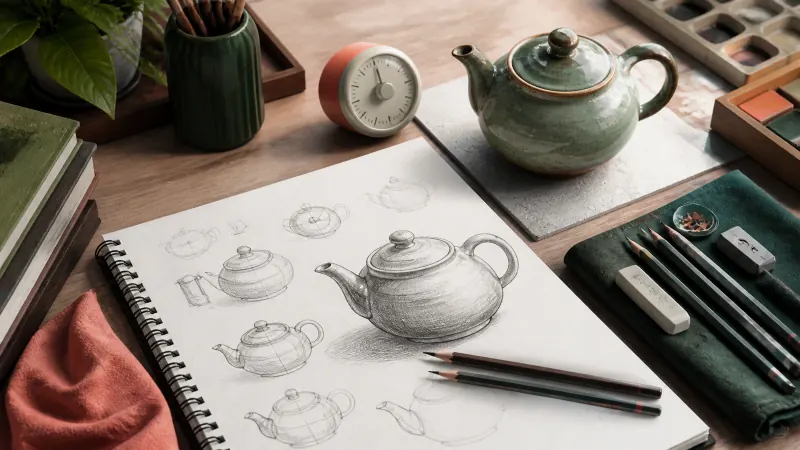
The blank page is the hardest part of any drawing session. You sit down ready to practise, then spend ten minutes deciding what to draw, and the motivation quietly drains away. An Object Generator removes that stall completely: press a button, get a real object, start sketching.
But a generator is only a subject dispenser. What turns it into actual skill development is the structure you build around it. This guide covers the warm-up routines, timed exercises and progression drills that make random prompts genuinely improve your drawing.
Why Random Subjects Build Skill Faster
Left to your own choices, you draw what you already draw well. That is human, and it is also why plateaus happen — you accumulate hours without accumulating range.
Random prompts break that loop in three specific ways:
- They remove selection bias. You will be handed cylinders, soft folds, reflective metal and organic shapes you would never have chosen.
- They shorten the runway. The decision is made before you sit down, so practice starts within seconds.
- They force problem-solving. An unfamiliar object has no memorised shortcut, so you have to observe and construct.
That third point is the one artists underestimate. Drawing a face from memory rehearses what you know. Drawing a colander requires you to work out how to describe a curved perforated surface — and that is where new skill actually forms.
The Ten-Minute Warm-Up
The single highest-value routine is a short warm-up before your real work. Generate five objects and give each one two minutes.
- Draw a batch of five in the Object Generator.
- Set a two-minute timer per object.
- Aim for accurate proportion and silhouette only — no detail, no shading.
- When the timer ends, move on regardless of how finished it looks.
The hard rule is the moving on. The point is not five good drawings; it is loosening your hand and switching your brain into observation mode before the session that matters.
Warm-ups fail when you let yourself finish them. The timer is the exercise.
Timed Challenges by Duration
Different time limits train different abilities. Rotating between them is more useful than always working at one speed.
| Time | Objects | What it trains |
|---|---|---|
| 30 seconds | 10 | Gesture, silhouette, decisive marks |
| 2 minutes | 5 | Proportion and basic construction |
| 10 minutes | 3 | Form, light logic, simple shading |
| 30 minutes | 1 | Surface, texture, material accuracy |
| 60 minutes | 1 | Full rendered study |
A practical weekly split: short sessions on four days, one long study at the weekend. Speed work keeps your marks confident; long studies build the observational depth that speed work alone never develops.
Five Drills That Use One Prompt
You can extract far more from a single object than one drawing.
Rotate It
Draw the same object from three angles — front, three-quarter, and from above. You cannot copy an image for all three, so you are forced to build a mental model of its volume.
Change the Light
Draw it three times with the light source from the left, from above, and from behind. This trains shading logic rather than shading habit.
Simplify Then Elaborate
First reduce the object to three basic solids. Then draw it again with full detail. This is the fastest route to understanding construction.
Change the Material
Draw the object as if it were glass, then chrome, then fabric. Same silhouette, entirely different surface problem.
Change the Scale
Draw it as a hand-held item, then as a building. Scale changes which details read and which disappear — a genuinely useful lesson for composition.
Building a Session That Sticks
A repeatable structure beats motivation. A reliable forty-minute session looks like this:
- 0–10 min: warm-up, five objects at two minutes each.
- 10–35 min: one long study from a single generated object.
- 35–40 min: review — note one thing that worked and one to fix next time.
That final review step is what converts practice into progress. Without it you repeat the same mistakes at higher volume.
Using Filters Deliberately
Category filters let you target a weakness instead of drawing at random within randomness.
| If you struggle with | Filter to |
|---|---|
| Curved and cylindrical form | Household, Food |
| Organic, irregular shapes | Nature, Animals |
| Hard-surface and mechanical detail | Tools, Tech |
| Fabric, folds and drape | Clothing |
| Perspective and large forms | Transport |
Spend a fortnight on one category before rotating. Concentrated exposure to a single class of problem produces visible improvement far faster than scattered variety.
Drawing From Memory Versus Reference
A generated prompt gives you a choice most reference-first workflows never offer: you can attempt the object before looking at one. Both routes are worth using, for different reasons.
Draw from memory first and you immediately discover what you actually know. Almost everyone finds their mental image of a bicycle, a stapler or a pair of scissors collapses the moment they try to put it down. That failure is diagnostic — it shows you precisely which forms you have seen thousands of times but never observed.
Then find a reference and draw it again. The second attempt sticks far better than a reference-only drawing would, because you already know which part you got wrong and your attention goes straight there. This memory-then-reference pairing is one of the highest-return habits available, and it costs only a few extra minutes per object.
Keeping a Record
Note the seed alongside each session in your sketchbook. Months later you can regenerate the identical set and redraw it, which gives you an honest side-by-side comparison of your progress. It is the most direct measure of improvement available, and it costs nothing. Seeds are explained here.
If you want a longer structure to hang all of this on, the daily drawing challenge turns these drills into a thirty-day plan.
Frequently Asked Questions
How many objects should I generate per session?
Five for a warm-up, one for a long study. Generating twenty and drawing three creates a backlog that quietly becomes guilt.
Should I use reference photos for the generated objects?
Both approaches are valuable. Drawing from memory tests your mental library and exposes gaps; drawing from reference builds accuracy. Alternate deliberately rather than defaulting to one.
What if I get an object I have no idea how to draw?
That is the most useful prompt you will receive. Break it into basic solids, get the proportions right, and accept that the result will be rough. The difficulty is the training effect.
Is this useful for complete beginners?
Very. Beginners benefit most from removing the choice, because subject anxiety is a large part of what stops people starting at all. Begin with the kid-friendly filter for simple, familiar shapes.
Start Your Next Session Now
Open the Object Generator, draw five objects, and set a two-minute timer. You will be sketching before you would normally have finished deciding what to sketch — and over a few weeks, that reclaimed time is what turns into visible skill.