The single biggest predictor of improvement in drawing is not talent — it is showing up consistently. A daily drawing challenge builds that consistency, and an Object Generator removes the one thing that usually derails it: deciding what to draw. Press a button, get a subject, and start.
This guide gives you a complete thirty-day plan, the rules that keep a streak alive when motivation dips, and the common mistakes that quietly kill challenges in the second week.
Why Daily Beats Occasional
A ninety-minute session once a week and fifteen minutes a day add up to similar totals, but they do not produce similar results. Daily practice wins for reasons that have little to do with hours:
- Retention. Skills consolidate between sessions. Short gaps preserve more than long ones.
- Lower activation cost. Fifteen minutes is easy to start. Ninety is easy to postpone.
- Identity. Drawing every day makes you someone who draws, which is far more durable than motivation.
The failure point is almost never the drawing itself. It is the twenty minutes of scrolling for a subject that turns a fifteen-minute commitment into an hour-long one — and then into something you skip.
You are not building a drawing habit. You are building a starting habit. The drawing takes care of itself.
The Rules That Keep a Streak Alive
Set these before day one, not during week two when you are already struggling.
- Set a floor, not a target. The commitment is ten minutes. Longer is welcome, never required.
- Accept the prompt you get. No rerolling. Rerolling reintroduces the decision the tool was meant to remove.
- Finish nothing. A rough sketch counts. Completion is not the metric; attendance is.
- Never miss twice. One missed day is noise. Two consecutive missed days is how streaks end.
- Keep everything. Bad pages are the evidence of progress. Do not tear them out.
Rule two matters more than it looks. The moment rerolling is allowed, you drift back to comfortable subjects and lose the range that made random prompts worth using.
A Thirty-Day Plan
Each week has a focus, so the challenge develops a specific skill rather than just accumulating pages. Generate one object each day in the Object Generator using that week's category filter.
| Week | Filter | Focus | Time |
|---|---|---|---|
| 1 (days 1–7) | Household, Kid-Friendly | Silhouette and proportion | 10 min |
| 2 (days 8–14) | Food, Nature | Organic form and volume | 15 min |
| 3 (days 15–21) | Tools, Tech | Hard surfaces and detail | 20 min |
| 4 (days 22–28) | All categories | Light, shadow, material | 25 min |
| 29–30 | Repeat week 1 seed | Compare against day 1 | 25 min |
Those last two days are the most valuable in the plan. Regenerating your week-one objects using the same seed and redrawing them gives you a direct, honest comparison — the same subjects, thirty days apart. It is far more convincing than a vague sense of having improved. Seeds work like this.
Variations When the Standard Format Goes Stale
Around day twelve, most challenges start to feel mechanical. Switch format rather than quitting.
One Object, Three Angles
Draw the day's object from the front, from three-quarters, and from above. Same time budget, much more thinking.
Two-Object Combination
Generate two objects and draw them interacting — stacked, balanced, or one inside the other. This introduces composition without adding time.
Sunday Long Study
Six quick days, one forty-five-minute rendered study at the weekend. This keeps the weekday floor genuinely low.
Constraint Days
Pick a limitation for the day: no erasing, ink only, one continuous line, or your non-dominant hand. Constraints refresh a routine faster than new subjects do.
What Kills Challenges (and the Fix)
| Failure mode | Fix |
|---|---|
| Daily target set too high | Lower the floor to ten minutes and keep it there |
| Rerolling for an easier object | Accept the first prompt, always |
| Trying to produce finished work daily | Reserve finishing for one day a week |
| Comparing your day 6 to someone else's year 6 | Compare only against your own day 1 |
| Missing two days in a row | Restart the same day, not next Monday |
The last row deserves emphasis. Waiting for a clean restart date turns a two-day gap into a two-week one. Resume mid-week, mid-month, mid-anything.
What to Expect Week by Week
Knowing the shape of the month in advance stops normal dips from feeling like failure.
- Days 1–4. Easy. Novelty carries you and the drawings feel surprisingly good.
- Days 5–10. The first dip. Novelty fades, the work looks worse than day two, and skipping starts to seem reasonable. Nothing has gone wrong — your judgement is improving faster than your hand, which is the normal order.
- Days 11–18. The routine becomes automatic. This is where the habit actually forms.
- Days 19–30. Visible gains, particularly in speed and confidence of line. Compare against week one rather than against anyone else.
The dip around day seven is the only genuinely dangerous stretch. It is not a signal to stop or to raise your effort — it is the point at which lowering the daily floor to five minutes keeps the chain intact until momentum returns.
Tracking Without Overhead
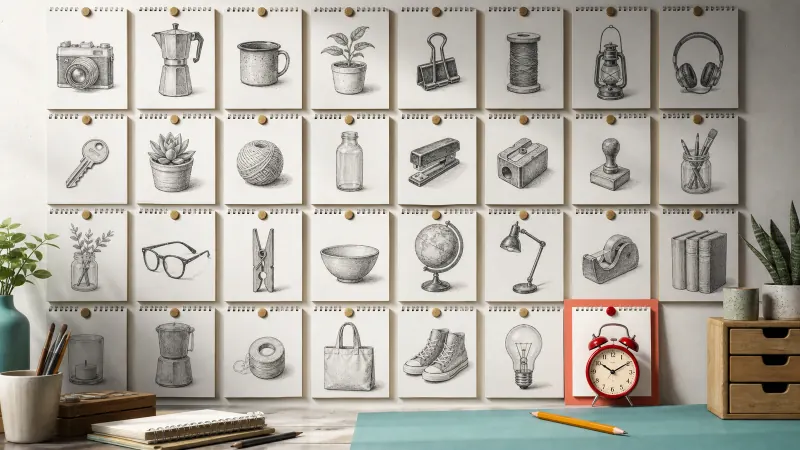
Keep it light or it becomes another task to skip. Date each page, write the object name and the seed in the margin, and mark the day on a simple calendar grid. The visible chain of marks does real motivational work — breaking a run of twenty starts to feel like a genuine loss.
If you want more structure inside each session, the drawing practice guide covers warm-ups and timed drills in depth. For prompt ideas when you want to browse rather than generate, there is a curated list of fifty objects.
Frequently Asked Questions
How long should each day actually take?
Ten to fifteen minutes is the sweet spot for a sustainable streak. Anything above thirty minutes daily tends to collapse within a fortnight for most people.
What if I miss a day?
Draw the next day. A single gap has no effect on skill development; the only real risk is letting one gap become a habit of gaps.
Should I post my drawings publicly?
Only if it helps you. Public accountability motivates some people and creates quality pressure for others — which is the opposite of what a low-floor daily habit needs.
Can I do this with a phone instead of paper?
Yes. The generator works well one-handed on mobile, and a drawing app is a perfectly valid surface. Mobile tips are here.
Start Today, Not Monday
Open the Object Generator, filter to Household, draw one object, and give it ten minutes. Day one is the only day that requires a decision — every day after it, the tool decides for you.