Still life is one of the oldest and most rewarding ways to practise drawing and painting — but arranging a fresh setup every session gets old fast. You reach for the same bowl, the same bottle, the same folded cloth, and the studies stop teaching you anything.
An Object Generator keeps still life practice alive by suggesting combinations you would never assemble yourself. This guide covers how to build a setup from random prompts, the composition rules that make an arrangement work, and how to turn generated objects into a structured study programme.
Why Random Beats Chosen for Still Life
When you choose your own objects, you unconsciously select for two things: items you find attractive, and items you already know how to render. Both work against you.
A random set forces genuinely new problems. Pair a wine glass with a pine cone and you have transparency next to irregular repeating structure — a combination you would not have picked, and precisely the kind that builds range. The friction is the point.
There is also a compositional benefit. Objects with no natural relationship force you to create one through placement, overlap and lighting. That is a harder and more valuable exercise than arranging things that already belong together.
A still life you would never have chosen is a still life that teaches you something you do not already know.
Building a Setup From Generated Objects
Generate three objects in the Object Generator and substitute what you have to hand for anything unavailable — a similar shape and surface is close enough. Then arrange them using these principles.
Vary the Heights
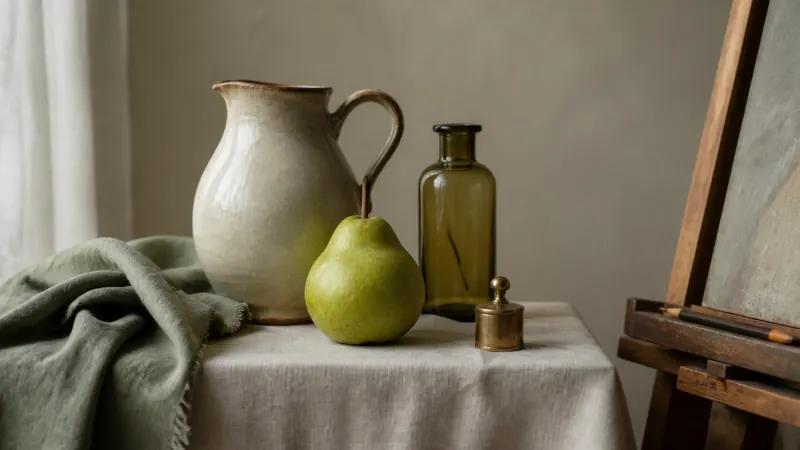
Three objects of similar height read as a row. Aim for a tall element, a medium one and something low and horizontal. If the generator gives you three short objects, raise one on a book.
Overlap Deliberately
Objects that touch or overlap create depth; objects with visible gaps between them read as separate studies sharing a page. Overlap at least one pair.
Build an Odd-Numbered Group
Three and five arrange more comfortably than two, four or six. Even numbers tend to split visually into pairs.
Leave One Dominant
Let one object be clearly the largest or most visually complex. Equal weighting gives the eye nowhere to settle.
Use a Single Light Source
One directional lamp from the side produces readable form and a coherent shadow pattern. Overhead room lighting flattens everything and is the most common reason a setup looks dull.
A Progressive Study Programme
Increase difficulty deliberately rather than generating three objects forever.
| Stage | Setup | Focus |
|---|---|---|
| 1 | One object, plain background | Proportion, ellipse, single-source shading |
| 2 | Two objects, overlapping | Relative scale and cast shadow |
| 3 | Three objects, varied heights | Composition and visual hierarchy |
| 4 | Three objects plus drapery | Folds and background integration |
| 5 | Five objects, mixed materials | Surface differentiation across one scene |
Spend at least a week at each stage. Moving up before the current level feels comfortable produces frustration rather than progress.
Matching Categories to Surface Problems
Filters let you target a specific rendering skill instead of leaving it to chance.
- Food — glossy, matte and translucent surfaces in fast-to-finish subjects.
- Household — ceramics and cylinders; the classic ellipse training ground.
- Tools — metal, reflection and hard edges.
- Nature — irregular organic form with no symmetry to fall back on.
- Clothing — drapery, which most artists avoid for longer than they should.
A useful drill: keep the same three objects for a full week and change only the lighting each day. Same subject, five entirely different studies, and it isolates light as a variable in a way changing subjects never does.
Working Without the Physical Objects
You will not own a sextant or a hot air balloon. Three workable approaches:
- Substitute by form. Swap in something with a comparable silhouette and surface. The technical problem is preserved.
- Use reference. Photograph or find images of each object and construct the arrangement on the page.
- Draw from imagination. Hardest, and the most revealing about gaps in your visual library.
Imaginative construction is worth attempting occasionally even when the objects are available. It exposes exactly which forms you understand and which you have only ever copied.
Common Still Life Mistakes
Most disappointing studies fail for the same small number of reasons, and all of them are fixable before you make a single mark.
| Mistake | What it looks like | Fix |
|---|---|---|
| Flat lighting | Objects look pasted on, no sense of volume | One lamp, side-on, room lights off |
| Eye-level viewpoint | Ellipses collapse into straight lines | Sit higher or lower than the objects |
| No cast shadows | Objects float above the surface | Draw the shadow shape before the object detail |
| Everything equally detailed | The eye has nowhere to rest | Fully render one focal object, suggest the rest |
| Ignoring the background | A hard edge where the table meets nothing | Include the surface plane and its tone |
The cast shadow is the one worth prioritising. It anchors an object to its surface more convincingly than any amount of rendering on the object itself, and it costs almost no extra time to include.
Recording Your Setups
Note the seed with each session. Months later you can regenerate the identical object set and redraw it — the same still life, with your improved eye. It is the most honest progress measurement available. Seeds are explained here.
For shorter warm-ups before a long study, the drawing practice guide covers timed drills, and there is a list of fifty subjects if you would rather browse than generate.
Frequently Asked Questions
How many objects should a still life contain?
Start with one and build to five. Beginners commonly overload a setup, then spend the session managing complexity instead of observing carefully.
What if the generated objects clash visually?
That is the exercise. Unifying unrelated objects through lighting, placement and a consistent surface is one of the most transferable compositional skills there is.
Does this work for painting as well as drawing?
Yes, and the varied surfaces matter more in paint. Mixed materials in one setup force decisions about temperature, edge quality and value relationships.
How long should a still life study take?
Thirty minutes for a single object, ninety minutes to three hours for a full arrangement. Timed short studies also have value, but still life rewards sustained observation.
Build One Tonight
Open the Object Generator, draw three objects, substitute freely from your kitchen, and set one lamp to the side. The setup you would never have chosen is usually the one worth drawing.