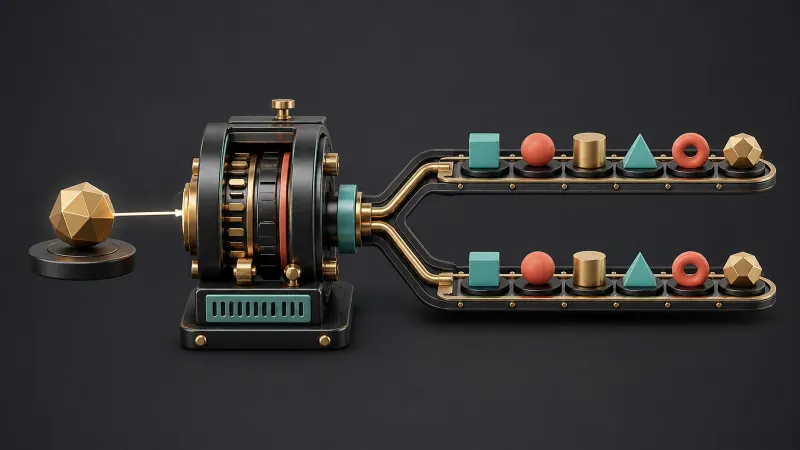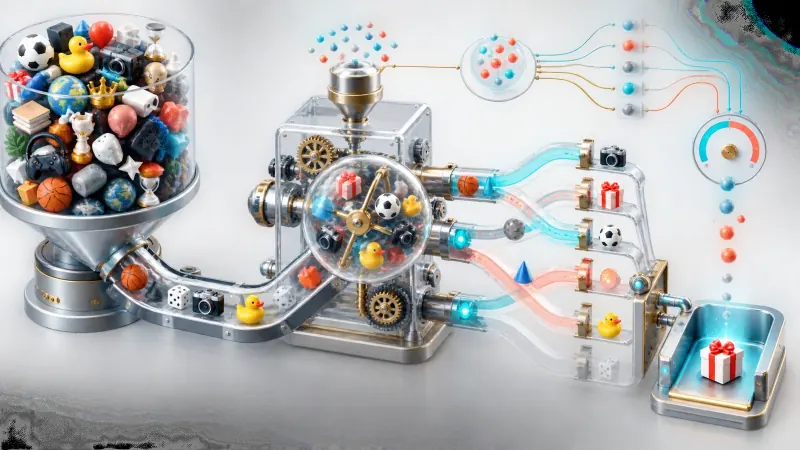
An Object Generator feels a little magical — you press a button and a genuinely unpredictable object appears. There is no magic involved, just a handful of understandable ideas working together: a curated word list, a pseudorandom number generator, a seed, and a few rules that stop the output from feeling repetitive.
Once you can see the machinery, you can also judge it. This guide walks through each moving part in plain English, then shows what separates a generator that stays interesting for months from one that feels stale by the third press.
Part One: The Word List
Everything starts with the pool. A generator can only ever return something already on its list, so the list is the single biggest factor in output quality.
Building one is more editorial than technical. Pull nouns straight from a dictionary and you get proper nouns, plurals, archaic terms and abstractions — a flood of results nobody can draw or act out. A usable pool is hand-filtered against a few tests: the word must name a physical thing, most people must picture roughly the same object on hearing it, and it must have a silhouette distinctive enough to sketch.
Size matters for a specific mathematical reason. If a pool holds only fifty objects, you will see a repeat within a handful of draws simply by probability. Push the pool past five hundred and repetition stops being noticeable in normal use. Categories then subdivide that pool, letting you narrow to Food or Tools without dropping to a list so short it starts cycling.
Part Two: Pseudorandom Numbers
Computers cannot produce true randomness on their own. What they run is a pseudorandom number generator: a formula that takes a number, scrambles it through arithmetic, and returns a new number that appears unrelated to the last. Feed each result back in and you get a long stream of numbers with no visible pattern.
To turn a number into an object, the generator scales it to the length of the list and uses it as an index. A pool of 560 objects means the number is mapped into the range 0–559, and whatever sits at that position is your result.
"Pseudo" sounds like a weakness, but for creative work it is irrelevant. The sequence is deterministic in principle and unpredictable in practice, which is exactly the behaviour you want. True hardware randomness matters for cryptography, not for choosing what to sketch.
Pseudorandom means the computer is following a rule you cannot see. That is indistinguishable from randomness for every purpose that matters here.
Part Three: The Seed
Every pseudorandom sequence needs a starting number, and that number is the seed. It determines the entire chain of results that follows.
This has a useful consequence. Because the same seed always produces the same sequence, randomness becomes reproducible on demand. Two people entering an identical seed receive identical objects in identical order — which is how a teacher gives thirty students the same prompts, or how a drawing group runs a shared challenge without screenshots. We cover the practical side in our guide to seeds.
When you do not supply a seed, the tool generates one for you, usually from the current time. That is why every fresh visit produces different results.
Part Four: The No-Repeat Rule
Pure randomness has a property people find surprising: it clumps. Ask for twelve objects with no constraints and duplicates are likely, because each draw is independent and has no memory of the last.
Generators solve this with sampling without replacement. Instead of picking twelve times from the full pool, the tool removes each chosen object before the next draw, guaranteeing every item in the batch is unique. The technical name is a shuffle — typically a Fisher–Yates shuffle, which reorders the list in a single pass and takes the first N items.
Most tools make this optional, and both settings have a use:
- No-repeat on — worksheets, drawing lists, Pictionary rounds, anything where a duplicate wastes a slot.
- No-repeat off — long game sessions where a word reappearing is harmless, or when you want statistically pure draws.
Part Five: Filters and Weighting
Category filters work by narrowing the pool before selection, not by rejecting results afterwards. Choosing Nature and Animals builds a temporary sub-pool from just those entries, then runs the same selection process against it. This keeps the tool fast and ensures the filter never silently fails.
A kid-friendly switch works the same way, restricting the pool to simple, familiar, classroom-safe objects. Because it is a pool restriction rather than a post-filter, there is no chance of an unsuitable object slipping through.
Some generators also weight results, making common objects appear more often than obscure ones. This is a judgement call: weighting produces more usable prompts but slightly less variety. Unweighted selection treats a spoon and a sextant as equally likely, which is more surprising but occasionally less practical.
What Makes One Generator Better Than Another
| Component | Weak implementation | Strong implementation |
|---|---|---|
| Word list | Scraped, unfiltered, under 100 entries | Curated, concrete, several hundred entries |
| Selection | Repeats inside a single batch | Optional no-repeat via shuffle |
| Seed | Hidden from the user | Shown, editable, shareable |
| Filters | Applied after selection | Applied to the pool before selection |
| Where it runs | Server round-trip per press | Entirely client-side, instant |
That last row is worth noting. A generator that runs fully in your browser responds instantly, keeps working on a weak connection, and never sends your activity anywhere. There is no technical reason a word-picking tool needs a server.
Frequently Asked Questions
Is the output truly random?
It is pseudorandom — produced by a formula rather than a physical process. The results are unpredictable to a human observer, which is the only standard that matters for drawing prompts, lessons and games.
Why do I sometimes see the same object twice in a row?
Genuine randomness has no memory, so short-term repeats are expected and are actually evidence the tool is not being artificially tidied. Switching on the no-repeat option removes them inside a batch.
Does a bigger word list always mean a better tool?
Only up to a point. Beyond a few hundred well-chosen entries, curation matters more than raw count — a thousand-word list padded with abstractions is worse than five hundred concrete, drawable nouns.
Can I get the same results twice on purpose?
Yes. Note the seed shown with any draw and enter it again later. The generator will retrace the identical sequence.
See the Mechanism for Yourself
The clearest way to understand any of this is to test it. Open the Object Generator, note the seed on a batch, change a category filter, toggle no-repeat, then re-enter the original seed. Watching the same objects return on demand makes the whole system click in a way no explanation quite manages.