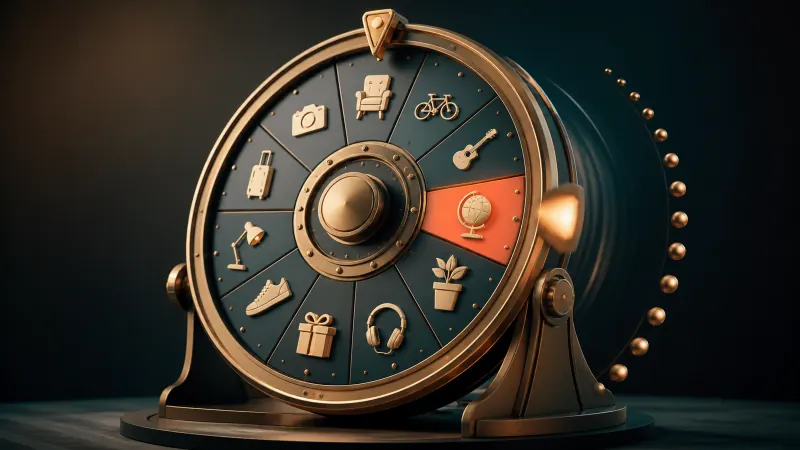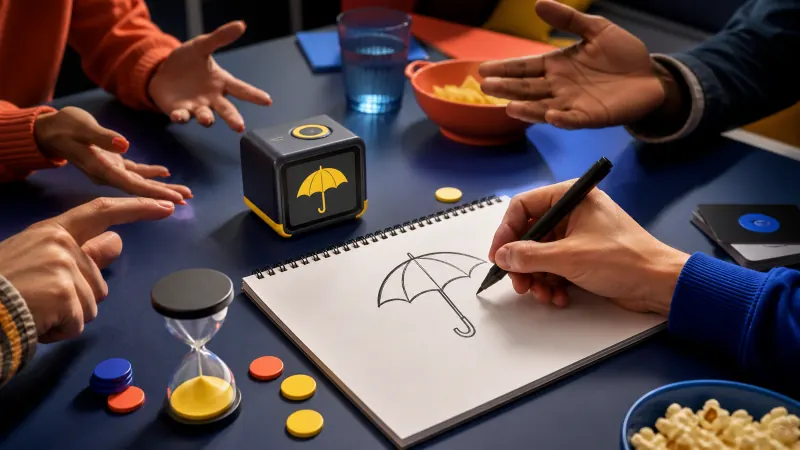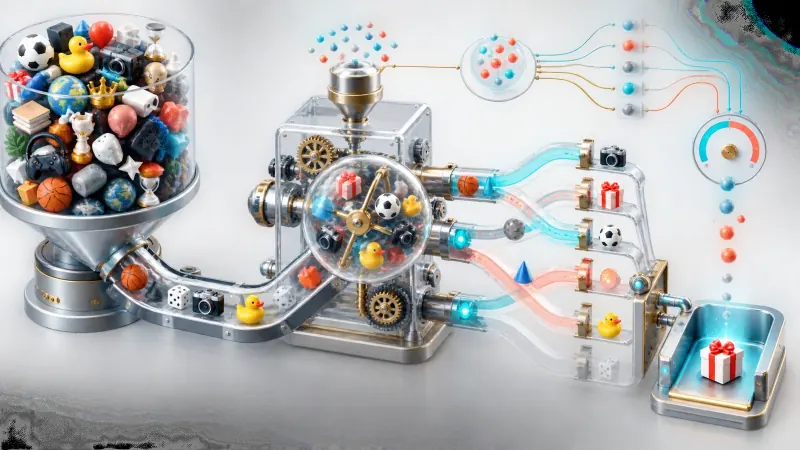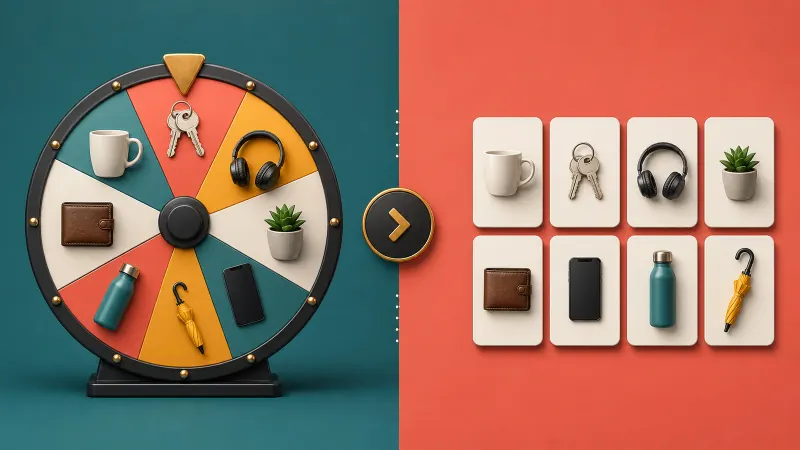
Search for an Object Generator and you will find two main styles: a spinning wheel that lands on one object with a flourish, and a straightforward list that prints several results at once. Both draw on the same underlying idea, but they suit very different moments.
This comparison breaks down what each format does well, where each one costs you time, and how to pick the right one for your game, class or drawing session.
The Same Engine, Different Interfaces
It is worth stating plainly: neither format is more random than the other. Both select a pseudorandom number and map it to a position in a word list. The wheel then animates itself to land on the already-chosen result.
So the comparison is not about fairness or quality of randomness. It is entirely about interface — how many results you get per interaction, how many you can see, and what you can do with them afterwards.
Choose by how many objects you need and what happens next, not by which one feels more random. They are identical underneath.
The Spinning Wheel
A wheel is theatre. The spin builds anticipation, the slowdown creates suspense, and the landing feels like a decision the whole group witnessed together.
Where the Wheel Wins
- Live groups. A shared screen and a visible spin make everyone feel part of the outcome.
- Single picks. When you need exactly one object and want a moment around it.
- Younger children. The animation holds attention and makes turn-taking bearable.
- Perceived fairness. Watching every option cycle past feels impartial, which matters in competitive play.
Where the Wheel Struggles
Wheels become slow and awkward the moment you need more than one object. Spinning twenty times to build a drawing list is tedious, and most wheels can only display twelve to twenty segments legibly — which caps the pool you are actually drawing from and makes repeats common.
The List Generator
A list is efficient. Press once and get one object or forty-eight, instantly, with categories and filters to shape the pool. There is no animation to wait through.
Where the List Wins
- Batches. A full session of prompts in a single press.
- Large pools. No display limit, so all several hundred objects stay in play.
- Filtering. Narrow by category and count precisely, without rebuilding anything.
- No repeats. A batch-level guarantee that every object is unique.
- Reproducibility. Seeds let a group share an exact set — something a wheel cannot easily do.
- Export. Save results as text, spreadsheet or image files for worksheets and cards.
Where the List Struggles
A list has no ceremony. Results simply appear, which is ideal when you are working and slightly flat when you are entertaining a room of eight-year-olds.
Direct Comparison
| Criterion | Wheel | List |
|---|---|---|
| Objects per interaction | One | One to forty-eight |
| Practical pool size | Limited by display | Unlimited |
| Suspense | High | None |
| Speed for batches | Slow | Instant |
| No-repeat guarantee | Rare | Standard option |
| Seed sharing | Uncommon | Common |
| Export options | Usually none | Text, CSV, images |
| Works one-handed on mobile | Moderate | Good |
Which to Use, by Situation
| Situation | Use |
|---|---|
| Picking one challenge subject for a stream | Wheel |
| Preparing sixteen prompts for a lesson | List |
| A party game with a shared screen | Wheel, or list revealed one at a time |
| A week of daily drawing subjects | List |
| Keeping a class working from identical prompts | List with a shared seed |
| An energiser for young children | Wheel |
| Building a printed worksheet | List with export |
The Hidden Cost of Segment Limits
The wheel's display ceiling has a consequence most people never notice, and it is worth spelling out because it changes the character of the results.
If a wheel shows sixteen segments, you are not drawing from a large pool — you are drawing from sixteen objects, repeatedly. Probability then works against you quickly: with sixteen options, a repeat becomes likely within about five spins. Over a party evening, players start recognising the same handful of objects, and the sense of endless variety that made the tool appealing quietly disappears.
Some wheels address this by reshuffling segments between spins, drawing a fresh sixteen from a larger hidden pool each time. That helps, but it also undermines the format's main psychological benefit — watching every option cycle past is only reassuring if those really were all the options.
A list has no equivalent constraint. All several hundred objects remain eligible on every draw, so the variety you are promised is the variety you actually get.
Getting Both at Once
The two are not mutually exclusive, and the practical answer for most groups is a hybrid. Generate a batch with a list, then reveal the objects one at a time.
Your audience gets the suspense of a slow reveal; you get the speed, the larger pool, the no-repeat guarantee and an exportable record. Adding a three-second countdown before each reveal recreates most of a wheel's tension at no cost.
For competitive play there is a stronger fairness move than any animation: announce the seed before the round. It proves the prompts were fixed before anyone saw them, which a spin cannot demonstrate. Seeds are explained here.
Frequently Asked Questions
Is one format more random than the other?
No. Both use the same selection method. The wheel simply animates a result that was already determined.
Can a wheel handle hundreds of objects?
Not visibly. Beyond about twenty segments the labels become unreadable, which removes the only real advantage a wheel has over a list.
Which is better for classroom use?
A list for preparation and a slow reveal for delivery. A shared seed also keeps every student on identical prompts, which a wheel cannot do. Our classroom guide covers this.
Which works better on a phone?
A list. Wheels need screen area for legible segments, while a list scrolls comfortably under a thumb. See our mobile tips.
Do I lose anything by not using a wheel?
Only the animation. Every functional advantage — pool size, batching, filtering, no-repeat, export — sits with the list.
Try the Hybrid
Open the Object Generator, switch on no-repeat, draw sixteen objects, and reveal them to your group one at a time with a countdown. It is the fastest format with most of the drama — and a full list left over when you are done. For more on spin-style tools specifically, see our guide to the object generator wheel.