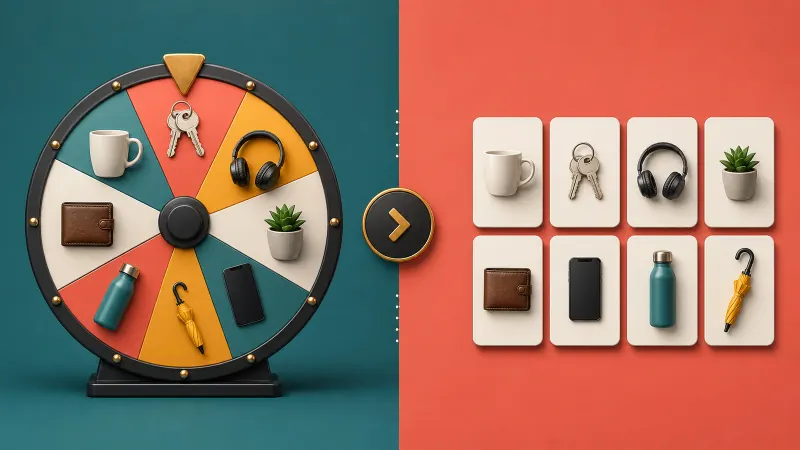
An Object Generator wheel takes the plain idea of "pick an object at random" and wraps it in a spin. You tap, it whirls through a ring of objects, slows, and lands on one with a satisfying click. For a live group, that small burst of suspense is the entire appeal.
This guide explains how spin-style pickers actually work, where the format genuinely wins, where it quietly costs you time, and how to decide which style suits what you are doing.
How a Spin Wheel Works
The animation is theatre, not mechanism. Under the surface the tool picks a result exactly as any generator does — a pseudorandom number scaled to the length of the list — and then animates the wheel so it stops at that already-chosen segment.
This matters for two reasons. First, the spin duration has no effect on the outcome; a longer animation is not "more random". Second, the wheel can only display a limited number of segments before the labels become unreadable, which places a hard ceiling on how many objects a wheel can hold at once.
The wheel does not decide anything. It performs a decision that was already made the instant you tapped.
Where the Wheel Genuinely Wins
Live Groups and Shared Screens
A spin is a shared event. Everyone watches the same wheel slow down, which creates a collective moment that a list appearing instantly cannot. For classroom energisers, party games and streams, that moment has real value.
Perceived Fairness
People trust what they can watch. A wheel visibly cycling past every option feels demonstrably impartial in a way instant output does not — even though both are equally fair. In competitive settings, perception matters as much as reality.
Younger Children
The animation holds attention and makes waiting for a turn tolerable. For under-eights, the spin often is the game. Our guide for kids covers age-appropriate formats.
Single Decisive Picks
When you need exactly one object and want ceremony around it — choosing a challenge subject, picking a prize category — the wheel suits the moment.
Where the Wheel Costs You
- Batches are painful. Twenty objects means twenty spins and twenty animations. What takes one press elsewhere takes several minutes here.
- The visible pool is small. Most wheels display twelve to twenty segments legibly, so you are drawing from a fraction of a real object pool.
- Repeats are common. With a small visible set, the same object reappears quickly unless the tool removes segments as they are drawn.
- Filtering is clumsy. Changing categories usually means rebuilding the wheel rather than toggling a filter.
- Results are hard to keep. A wheel shows one result at a time, so there is no list to copy, export or hand to a class.
The batch problem is the decisive one for most serious use. A teacher preparing sixteen prompts, or an artist building a week of drawing subjects, is badly served by an interface that produces one item per animation.
Wheel Versus List at a Glance
| Need | Better format | Why |
|---|---|---|
| One dramatic pick | Wheel | Suspense and a shared moment |
| Sixteen prompts for a lesson | List | One press instead of sixteen spins |
| Large object pool | List | No display limit on the pool |
| Guaranteed no repeats | List | Batch-level no-repeat option |
| Reproducible results | List | Seeds let a group share an exact set |
| Young children | Wheel | The animation holds attention |
| Exporting or printing | List | TXT, CSV and image export |
A fuller side-by-side is in our wheel versus list comparison.
Why Spins Feel Fairer Than They Are
The wheel's most interesting property is psychological rather than technical. People consistently trust a visible spin more than an instant result, even when told both use identical selection.
Two effects are at work. Watching every option pass by provides apparent proof that nothing was excluded — you saw the whole set, so the choice must have been open. And the delay itself implies effort; a result that takes three seconds to arrive feels considered, while one that appears instantly feels asserted.
Neither perception reflects anything real about the randomness. But perception is not worthless. In a competitive game, a group that believes the prompt was fair argues less, and a classroom that trusts the selection accepts a difficult word without complaint. If your situation involves people who might question the outcome, the wheel is buying you something genuine — just not statistical fairness.
The stronger alternative, where it is available, is announcing a seed before the round. That is actual evidence rather than the appearance of it, since the prompts were provably fixed before anyone saw them.
Getting the Drama Without the Cost
You do not actually need a wheel to get a wheel's benefits. A few approaches that keep the ceremony and drop the overhead:
- Batch first, reveal slowly. Generate sixteen objects privately, then reveal one per round. The group experiences suspense; you avoid sixteen animations.
- Use a countdown instead. A three-second verbal countdown before showing the object produces most of the same tension.
- Hand the device over. Letting a different person press each round creates the participatory feeling the spin provides.
- Announce the seed first. In competitive play, stating the seed before the round proves nothing was chosen afterwards — stronger fairness evidence than any animation. Seeds are explained here.
Frequently Asked Questions
Is a spin wheel more random than a list?
No. Both use the same underlying selection. The animation is presentation only and has no effect on which object is chosen.
Does spinning harder or longer change the result?
No. The result is determined the moment you tap; the wheel is then animated to land on it.
Can a wheel hold hundreds of objects?
It can hold them in memory, but it cannot display them legibly. Once segments become unreadable the visual advantage — seeing every option cycle past — disappears, which is the wheel's whole point.
Which should I use for a classroom?
A list for preparing activities, and reveal one at a time for delivery. You keep the suspense where it helps and avoid spinning through an entire lesson.
Try the Faster Format
Open the Object Generator, draw sixteen objects with no-repeat switched on, and reveal them one at a time to your group. You get the anticipation of a wheel with none of the waiting — and a full list you can export when you are done.