Pictionary lives or dies on its word list. Pick words that are too abstract and rounds drag; reuse the same cards and everyone memorises them. An Object Generator solves both problems by producing fresh, concrete, drawable nouns on demand — and because the tool chooses, nobody can accuse the word-picker of favouritism.
This guide covers setup, difficulty tuning, scoring, and the house rules that keep a game moving when a round stalls.
Why Objects Beat Word Lists
A general word generator will hand you meanwhile, optimism and therefore — technically words, practically unplayable. Roughly half the results in a Pictionary context are unusable, and every skip kills momentum.
An object generator is restricted to physical things by design. Every result has a silhouette, which means every result is drawable. The difference is not subtle: a game run on objects almost never needs a reroll.
The fairness point matters just as much. In any competitive game, the accusation eventually arrives that someone got an easier word. When the prompt comes from a tool that nobody controls, the argument disappears before it starts.
The best Pictionary word is one nobody chose, nobody has seen before, and everybody can picture.
Setting Up a Game
- Split into two teams. Three to five players each works best; larger teams leave people idle.
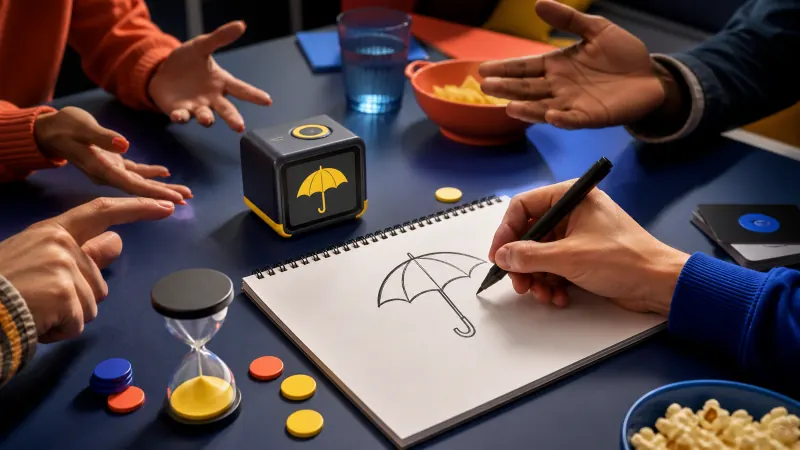
- Open the generator on one device. A phone passed to the current drawer is enough — no printing, no cards.
- Set your categories. Leave all on for a general game, or filter to match the group.
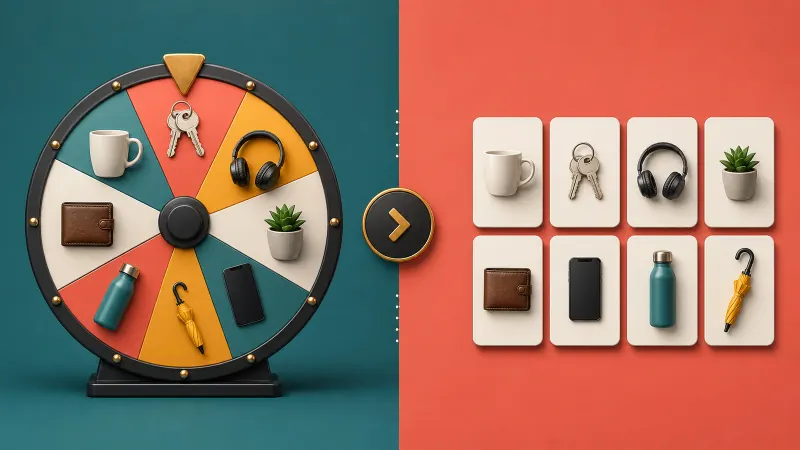
- Draw a batch before you start. Generate sixteen objects in one press so you are not returning to the tool between rounds.
- Switch on no-repeat. This guarantees every object in the batch is unique, so no team draws the same word twice.
Batching is the detail most groups miss. Generating one object per round means handing the phone around and waiting; generating sixteen at the start means the game never pauses. You can set this up in the Object Generator in about twenty seconds.
Tuning Difficulty
Difficulty in Pictionary comes from the category, not from obscurity. These filters give reliable results:
| Difficulty | Categories | Time per round | Best for |
|---|---|---|---|
| Easy | Kid-friendly, Animals, Food | 90 seconds | Children, mixed ages, warm-up rounds |
| Standard | Everyday, Household, Nature | 60 seconds | Most groups |
| Hard | Tools, Tech, Transport | 60 seconds | Experienced players |
| Very hard | All categories, no filter | 45 seconds | Tie-breakers and final rounds |
A good structure for a full evening: start easy to build confidence, move to standard for the bulk of the game, and use hard only for the deciding round. Opening on hard tends to deflate a group before it has warmed up.
Scoring That Keeps Games Close
Straight one-point-per-correct-guess works, but a few variations keep games competitive to the end:
- Speed bonus. Two points if guessed within thirty seconds, one point after.
- Steal. If the drawing team fails, the opposing team gets one guess for a single point.
- Category multiplier. Hard-category objects are worth double.
- Comeback rule. A team more than five points behind draws from an easier category.
The comeback rule is worth adopting. Pictionary is prone to runaway scores, and a game that is decided by round four stops being fun for half the room.
House Rules Worth Agreeing First
- No letters, numbers or symbols. The standard rule, and the one most often bent.
- One pass per team per game. Enough to escape a genuinely awkward object without allowing fishing for easy ones.
- Plurals and close forms count. If someone shouts "keys" for "key", award it. Arguing over grammar kills pace.
- The drawer may not speak or gesture. Including nodding, which is the most common accidental cheat.
- Agree the seed for tournaments. Both teams face identical prompts, which makes results genuinely comparable. Seeds work like this.
Drawing Tactics Worth Knowing
Most players lose rounds not because the object was hard, but because they drew it in the wrong order. Three habits reliably improve a team's hit rate:
- Silhouette first, detail never. The outline carries almost all the recognition. Players who begin with texture or shading run out of time before the shape exists.
- Draw scale context. A tiny box next to a stick figure reads as a matchbox; the same box alone could be a building. One reference object solves ambiguity instantly.
- Show the object in use. A hand holding it, or an arrow indicating motion, communicates function far faster than a static outline.
For guessers, the useful discipline is shouting broad categories early. "Something in a kitchen" narrows the drawer's next few strokes far more usefully than silence followed by a specific wrong answer at the buzzer.
Playing Online
The same setup works for video calls with one adjustment: share a seed rather than a screen. Everyone generates the same batch on their own device, so the drawer sees the prompt privately while the group works from an identical list. Use any shared drawing tool, or simply hold paper to the camera — the low-tech version works surprisingly well.
For groups who prefer the drama of a spin, our wheel guide covers that format, and the party games guide has six more games using the same prompts.
Frequently Asked Questions
How many objects do I need for a full game?
Sixteen covers roughly an hour with two teams. Generate twenty-four for a longer evening so you never have to stop and redraw.
What if someone gets an object they cannot draw?
That is the game. Use the one-pass rule for genuinely impossible cases, but most "impossible" objects turn out fine once someone starts drawing the outline.
Can we play with three people?
Yes. Rotate the drawer and have both other players guess competitively, with a point to whoever guesses first.
Is this better than a boxed Pictionary set?
For word variety, clearly — a printed deck is finite and gets memorised. A boxed set still wins on board, timer and pieces, so many groups use both.
Should we filter out hard categories entirely?
Only for young children. For adults, occasional difficult objects produce the most memorable rounds of the night.
Set Up in Twenty Seconds
Open the Object Generator, switch on no-repeat, draw sixteen objects, and pass the phone. That is a complete Pictionary night with nothing printed and nothing to argue about.