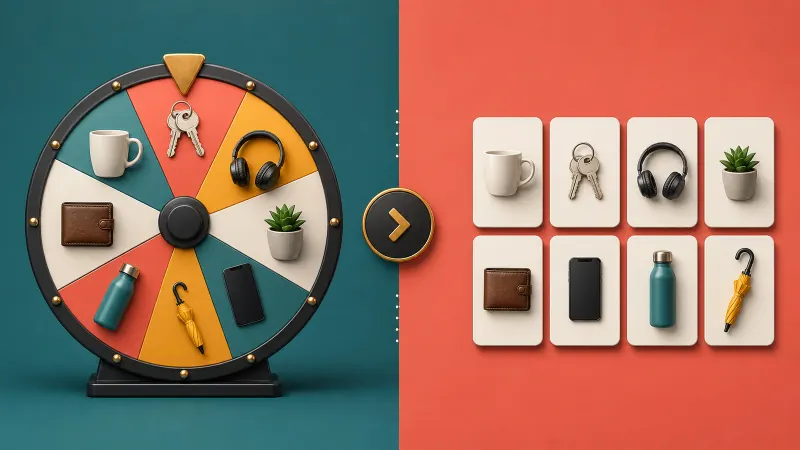
The best party games need almost no equipment and offer endless variety — which is exactly what an Object Generator provides. With one phone or a shared screen you can run a whole evening of games that never repeat, without printing cards or buying anything. Every round starts with an object nobody saw coming.
Here are seven games with clear rules, the group sizes they suit, and the practical setup that keeps an evening moving instead of stalling between rounds.
Before You Start
Two minutes of setup prevents most of the friction that ruins party games.
- Generate a batch, not one at a time. Draw twenty-four objects at the start. Passing a phone around between every round is what kills momentum.
- Switch on no-repeat so the same object never appears twice in a night.
- Pick categories to match the group. Kid-friendly for mixed ages, all categories for adults who want a challenge.
- Nominate one person to hold the device. A single scorekeeper and prompt-reader is faster than democracy.
You can set all of this up in the Object Generator in under a minute.
1. Draw It (3–12 players)
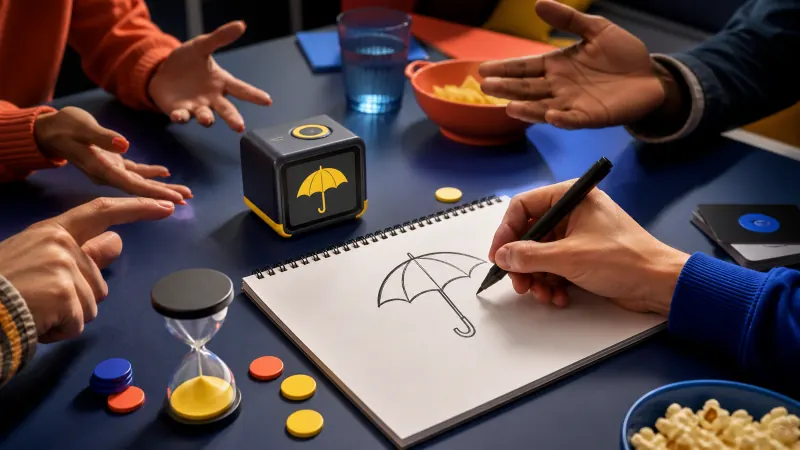
The classic. One player draws the generated object while their team guesses within sixty seconds. No letters, numbers or speaking.
Objects work far better than general word lists here because every result is physical and therefore drawable. Full setup, scoring and house rules are in our Pictionary guide.
2. Act It Out (4–16 players)
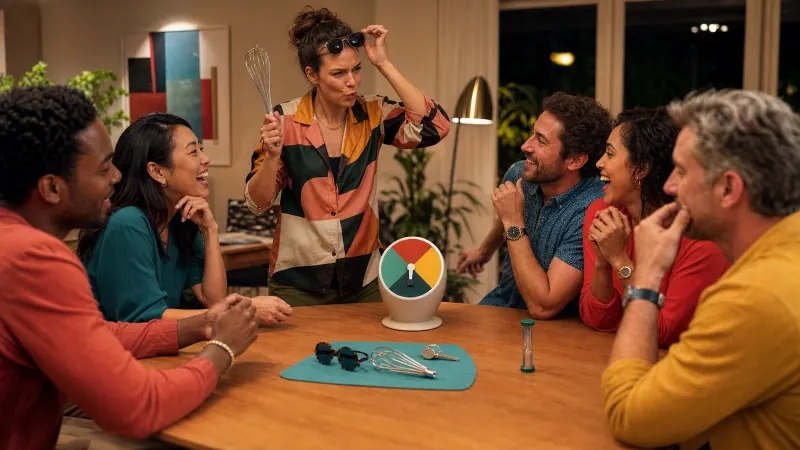
Charades with objects instead of films. The performer mimes the object — its shape, its use, how you hold it — without speaking or pointing at real examples in the room.
Objects are a gentler entry point than film titles, so this suits mixed-confidence groups. The rule that matters: no pointing at anything real, or half the objects become trivial.
3. One-Word Story (4–10 players)
Generate five objects and show them to everyone. The group tells a story one word at a time, going round the circle, and every object must appear in the story before it ends.
Quiet, funny and completely non-competitive. It suits the later part of an evening when nobody wants to jump around, and it works well with people who dislike performing.
The games that survive the whole evening are the ones where losing is as entertaining as winning.
4. The Auction (4–12 players)
Generate one object. Each player has sixty seconds to convince the group that this object is the single most valuable thing in a survival scenario — a desert island, a blizzard, a zombie outbreak. The group votes.
This produces the best arguments of the night. A hairbrush pitched convincingly against a fire extinguisher is funnier than either deserves, and quieter players often win because absurd sincerity beats volume.
5. Two Objects, One Invention (4–16 players)
Generate two objects. In pairs or small teams, players have three minutes to design a product combining both, give it a name, and pitch it in thirty seconds.
Works especially well with larger groups because everyone is busy at once rather than waiting for a turn. Also a genuinely good icebreaker for groups who do not know each other.
6. Guess the Connection (5–15 players)
One player secretly views four generated objects and invents a connection between them — all are found in a kitchen, all are round, all could be weapons in an emergency. They describe the objects one at a time; the group guesses the connection.
Rewards lateral thinking and gets more interesting the more tenuous the connection becomes.
7. Object Association Race (3–10 players)
Generate one object. Going round the circle, each player says something associated with it — no repeats, no hesitation longer than three seconds. Last player standing wins the round.
Fast, needs zero explanation, and works as a filler between longer games. Ideal for the awkward ten minutes while people are still arriving.
Choosing the Right Game
| Game | Players | Energy | Best moment |
|---|---|---|---|
| Draw It | 3–12 | Medium | Main event |
| Act It Out | 4–16 | High | Peak of the evening |
| One-Word Story | 4–10 | Low | Winding down |
| The Auction | 4–12 | Medium | After a few drinks |
| Two Objects, One Invention | 4–16 | Medium | Icebreaker |
| Guess the Connection | 5–15 | Low | Seated groups |
| Association Race | 3–10 | High | Filler between games |
Reading the Room
The most common party-game mistake is playing one game for too long. Energy in a room follows a curve, and the games should follow it too.
Open with something that requires no explanation and no courage — the Association Race works because latecomers can join mid-round without disrupting anything. Move to the physical games once the room is full and confident, because Act It Out needs an audience willing to react. Save the seated, low-energy games for the final hour, when people have found chairs and stopped wanting to stand up.
Two signals tell you to switch game: rounds start taking noticeably longer, or the same two people are doing all the performing. Neither means the game is bad; both mean it has run its course. Changing format resets attention far more effectively than adding rules or raising stakes.
Running Games Over Video Call
All seven work remotely with one adjustment: share a seed rather than a screen. Everyone enters the same seed and generates an identical set of objects on their own device, so the performer sees the prompt privately while the group works from the same list. It removes the awkward screen-sharing step entirely. Seeds are explained here.
Frequently Asked Questions
How many objects should I generate for a whole evening?
Twenty-four covers two to three hours across several games. Draw them in one batch with no-repeat switched on.
Do these work with children present?
Yes, with the kid-friendly filter on. Draw It, Act It Out and Association Race are the most age-inclusive. Our guide for kids has more.
What if the group is very large?
Above about sixteen, split into teams and run Two Objects, One Invention or Guess the Connection — both keep everyone occupied simultaneously rather than waiting for turns.
Do we need to keep score?
Only for Draw It and Act It Out. The rest are better without, because scoring makes people cautious and caution is the enemy of a funny answer.
Start the Evening
Open the Object Generator, switch on no-repeat, draw twenty-four objects, and start with the Association Race while people are still arriving. Nothing to print, nothing to buy, and no round is ever the same twice.