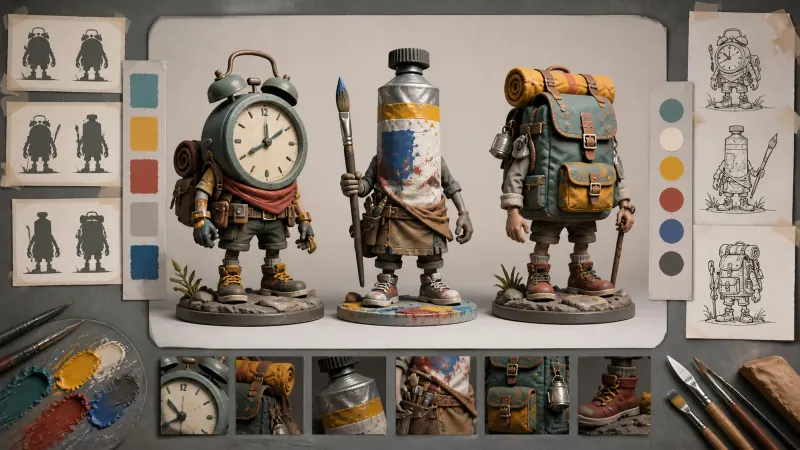
Writers stall for the same reason artists do: too many possibilities and no obvious place to start. An Object Generator gives you a concrete anchor — a single physical thing — to build a scene, a character or an entire story around. Constraint, it turns out, is one of the most reliable cures for a blank page.
This guide covers why objects work better than abstract prompts, specific techniques for turning a noun into a story, and exercises that fit into whatever time you actually have.
Why an Object Beats a Theme
Most writing prompts are abstractions: write about loss, write about betrayal. These sound generative but are usually paralysing, because they demand you invent the specific from the general — which is the hardest direction to work in.
An object reverses that. Give a writer a cracked pocket watch and the questions arrive on their own: whose is it, how did it crack, why is it still being carried? The theme emerges from the detail rather than the detail being deduced from the theme.
This matches how fiction actually communicates. Readers do not experience grief as a concept; they experience it as a character who cannot throw away a pair of shoes. Objects are the native currency of narrative.
Write about loss and you will produce an essay. Write about the shoes nobody can throw away and you will produce a story.
Six Ways to Turn an Object Into a Story
1. The Possession
Someone owns this object. Ask who they are, how they acquired it, and what would happen if they lost it. Ownership implies history, and history implies plot.
2. The Witness
Write the scene from the object's point of view. The forced distance strips out interiority and leaves you with pure observation — a strong corrective for writers who over-explain feelings.
3. The Anachronism
Place the object where it does not belong: a smartphone in 1850, a butter churn in a spaceship. The friction generates questions the story then has to answer.
4. The Turning Point
Make the object the hinge of the plot. It is found, stolen, broken or returned at exactly the moment everything changes.
5. The Repeated Motif
Have the object appear three times — once innocuously, once meaningfully, once decisively. This is one of the oldest structural devices in fiction and it works reliably.
6. The Absence
Write about the object being gone. Where it used to sit, who notices, what its outline in the dust implies. Absence often carries more weight than presence.
Exercises by Time Available
| Time | Objects | Exercise |
|---|---|---|
| 5 minutes | 1 | Describe it in exactly fifty words, no adjectives |
| 15 minutes | 1 | A scene in which someone refuses to give it up |
| 30 minutes | 2 | A conversation where both objects are present but unmentioned |
| 1 hour | 3 | A complete short-short story using all three |
| Ongoing | 5 | Five chapters, each opening with one of the objects |
The fifty-word, no-adjectives exercise is deceptively difficult and unusually useful. Stripped of adjectives you must rely on verbs and specificity, which is where most descriptive prose improves fastest.
Using Objects for Character
Objects reveal character more efficiently than description does. Generate three objects and assign them to a character:
- One they carry daily. Reveals routine, profession, self-image.
- One they keep hidden. Reveals shame, ambition or history.
- One they have lost. Reveals what they mourn.
Do this for two characters and the contrast between the six objects generates conflict before you have written a line of dialogue. It is faster than a character questionnaire and produces more usable material.
Beating a Block Specifically
When you are genuinely stuck rather than merely undecided, narrow the task aggressively. Generate one object, set a ten-minute timer, and write a single paragraph in which that object is touched by someone. Do not plan, do not connect it to your current project, and stop when the timer ends.
The purpose is not the paragraph. It is proving that writing is still possible today, which is usually the actual obstacle. For a broader method built on the same principle, see our guide to brainstorming with random prompts.
Making the Object Earn Its Place
The risk with object prompts is decoration: the thing appears, gets described beautifully, and does nothing. A prompt has only worked if the object is load-bearing.
Three tests are worth applying to a draft. Could you remove the object and leave the scene intact? If so, it is scenery rather than structure. Does anyone want something from it — to keep it, hide it, destroy it, retrieve it? Desire is what converts an object into a plot device. And does its meaning change between its first and last appearance? An object that means the same thing throughout has not participated in the story.
The strongest examples in fiction pass all three. A wedding ring that opens as a symbol of commitment and closes as evidence in an investigation has done structural work no amount of description could substitute for.
Group and Workshop Use
Random objects work well in writing groups because everyone receives the same constraint. Share a seed so all members generate an identical set, then compare how differently the same three objects were handled. The variation is the lesson — it demonstrates that voice, not subject matter, is what distinguishes writing. Seeds are explained here.
Frequently Asked Questions
How many objects should a prompt contain?
One for a scene, three for a complete story. More than five tends to produce writing that is busy servicing the constraint rather than following the story.
Does the object have to appear in the finished piece?
No. It frequently disappears in revision, having done its job of getting the first draft started. A scaffold does not need to remain in the building.
Is this useful for non-fiction?
Yes, particularly for memoir and essays. A generated object often triggers a specific memory far more effectively than trying to recall a theme.
What if the object seems too mundane?
Mundane objects are usually the strongest starting points. A spoon carries no genre expectations, so the story can go anywhere; a sword has already decided a great deal for you.
Start With One Object
Open the Object Generator, take a single object, and write one paragraph in which someone picks it up. That paragraph does not have to be good — it only has to exist, and that is usually all a stalled draft needs.