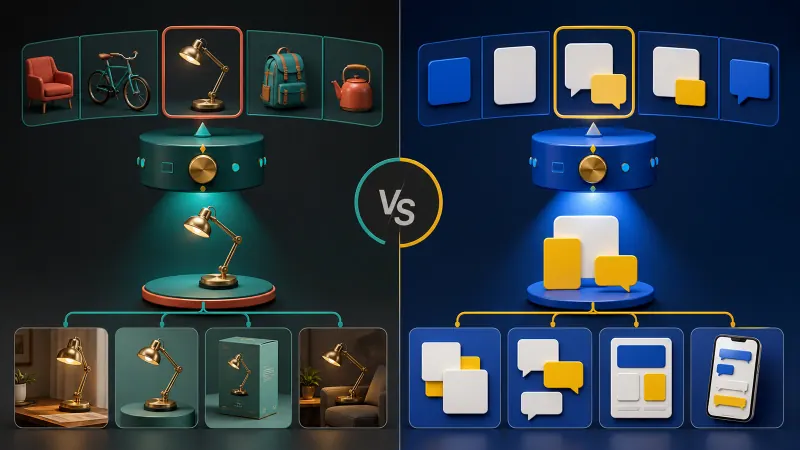
At first glance, a random object generator and a random word generator look like the same tool. Both produce unpredictable results at the press of a button. But the difference in what they produce — physical things versus any word at all — makes each one better suited to different tasks.
This comparison breaks down how they actually differ, which one to use for drawing, games, teaching and writing, and how to tell quickly which you need.
The Core Difference
A word generator draws from the whole language. Its pool includes verbs, adjectives, adverbs, abstract nouns and function words: running, bitter, meanwhile, nostalgia, therefore.
An object generator is deliberately restricted to concrete nouns — physical things you could point at, hold or photograph: umbrella, kettle, bicycle, pine cone.
That restriction is the entire product. It is not a smaller word generator; it is a filtered one, and the filtering is what makes every result immediately usable in tasks that require something picturable.
Ask whether your task needs a word or a thing. That single question answers the comparison almost every time.
Side by Side
| Aspect | Object generator | Word generator |
|---|---|---|
| Pool | Concrete physical nouns | All parts of speech |
| Every result usable for drawing | Yes | No, roughly half |
| Every result usable for charades | Yes | No |
| Vocabulary breadth | Narrower, focused | Very broad |
| Grammar practice | Nouns only | All word classes |
| Typical use | Art, games, lessons, prompts | Writing exercises, naming, word games |
| Reroll rate in practice | Very low | High |
That last row is the practical one. In a Pictionary round, a word generator forces a skip roughly every other draw. Repeated skipping is what turns a fast game into a slow one, and it is the single clearest argument for object-restricted tools in any physical or visual activity.
When to Use an Object Generator
Drawing and Art Practice
Every result has a silhouette, so every result is drawable. Abstract words have no visual form to study, which makes a general word generator close to useless here. See our drawing practice guide.
Pictionary, Charades and Party Games
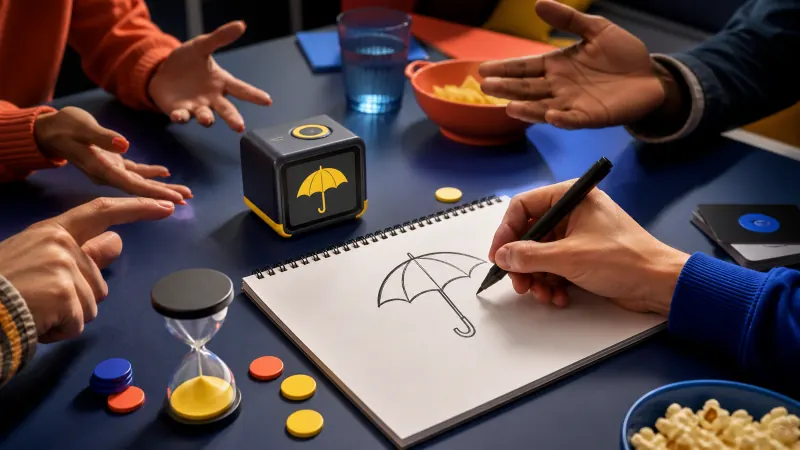
Games that require drawing or miming need physical subjects. An object generator eliminates the skip problem entirely. Full setup is in the Pictionary guide.
Early Language Learning
Beginners need concrete nouns before abstractions. Objects can be pointed at, held and described, which makes them the natural starting vocabulary. Our ESL guide covers this.
Still Life and Design Reference
Setups require things that physically exist. An abstract noun cannot sit on a table.
When to Use a Word Generator
Grammar and Sentence Construction
Practising verb tenses or adjective order requires verbs and adjectives. An object generator returns nouns and nothing else.
Poetry and Free Writing
Abstract and emotional words are often the point. A prompt of hollow or seldom opens directions no physical object would.
Naming and Branding
Brand names frequently come from adjectives and invented compounds, so breadth is an advantage rather than noise.
Word Games and Puzzles
Scrabble practice, anagrams and spelling drills need the full lexicon.
What "Concrete" Actually Means
The line between the two tools is the concrete–abstract distinction, and it is worth understanding because it explains every practical difference above.
A concrete noun names something perceivable by the senses. You can see a kettle, hold a stone, hear a bell. An abstract noun names a concept — justice, duration, confidence — which exists only as an idea. Between them sit borderline cases: music is heard but not held, shadow is seen but not touched, crowd is a collection rather than a thing.
A well-curated object generator resolves these edge cases editorially rather than grammatically. It excludes music because you cannot draw it, even though it is arguably concrete, and it excludes sextant not for being abstract but for being unrecognisable to most people. This is judgement no automated part-of-speech filter can replicate, and it is the real reason a hand-checked object list outperforms a filtered dictionary.
A Quick Decision Test
Ask three questions about your task:
- Does someone need to draw, mime or photograph it? If yes, use an object generator.
- Does the result need to be a specific part of speech other than a noun? If yes, use a word generator.
- Would an unusable result break the activity? If yes, use an object generator, because it has a far lower failure rate.
Most practical tasks resolve on the first question alone.
Using Both Together
The two are complementary rather than competing, and combining them is genuinely productive.
- Object plus adjective — "a rusted kettle", "a translucent hammer". Adds a rendering or descriptive challenge to a concrete subject.
- Object plus verb — "a bicycle, dissolving". Excellent for illustration and creative writing.
- Object plus abstract noun — "a teapot and regret". A strong writing prompt structure, since the object grounds the abstraction.
That last pairing is the basis of a great deal of effective short fiction: an abstract theme made visible through a specific physical thing. Our writing prompts guide develops this further.
Frequently Asked Questions
Can I just filter a word generator to nouns?
Partly. Filtering to nouns still leaves abstract nouns like freedom and duration, plus proper nouns and technical terms. A curated object list applies editorial judgement that a part-of-speech filter cannot.
Is an object generator just a smaller word generator?
It has a smaller pool but a much higher usable rate for physical tasks. Five hundred drawable objects outperform fifty thousand mixed words for drawing prompts.
Which is better for children?
An object generator, clearly. Concrete nouns match how young children acquire vocabulary, and every result can be drawn or acted out. Our guide for kids has more.
Which one for creative block?
Objects for visual work and for scene-level fiction. Words if you are stuck on tone or voice rather than subject.
Try the Object Version
If your task involves drawing, guessing, teaching or building a scene, open the Object Generator and draw a few results. The absence of unusable prompts is the difference you will notice first.